

What Is Story-Based Microlearning for Soft Skills?
What Is Story-Based Microlearning for Soft Skills?
Most of us have met soft skills training that tells people to listen carefully, communicate clearly and show empathy. All excellent advice. It is also about as helpful as telling someone to “just relax” five minutes before a meeting with a disgruntled client.
Story-based digital microlearning takes a more human route. It uses a short, recognisable workplace story to show a behaviour in action, the consequences of getting it wrong and what a better approach could look like. Instead of simply telling a manager not to interrupt, it lets learners watch the interruption land with all the grace of a dropped tray in a quiet café.
For soft skills training, that context matters. The best short digital learning does not take a long course, chop it into pieces and declare the job done. It focuses on one practical outcome, brings it to life through a believable situation and gives learners the chance to reflect, practise or apply what they have seen.
That is the difference between learning that happens to be short and learning that genuinely earns its place in a busy working day.
Story-based digital microlearning takes a more human route. It uses a short, recognisable workplace story to show a behaviour in action, the consequences of getting it wrong and what a better approach could look like. Instead of simply telling a manager not to interrupt, it lets learners watch the interruption land with all the grace of a dropped tray in a quiet café.
For soft skills training, that context matters. The best short digital learning does not take a long course, chop it into pieces and declare the job done. It focuses on one practical outcome, brings it to life through a believable situation and gives learners the chance to reflect, practise or apply what they have seen.
That is the difference between learning that happens to be short and learning that genuinely earns its place in a busy working day.
Digital microlearning: small, but not just a course put through the wash
Digital microlearning delivers a focused piece of learning in a short, accessible unit. Definitions vary, but microlearning is commonly described as content broken into bite-sized units that typically take around five to ten minutes. It can include video, text, quizzes, exercises, games and other interactive elements.
The word “short” tends to get most of the attention, but length is only part of the story. A five-minute course can still waste five minutes with impressive efficiency. Effective digital microlearning should:
- Address one clear learning objective.
- Remove information that does not support that objective.
- Be easy to access at the point of need.
- Connect the lesson to a real task, decision or behaviour.
- Give the learner a useful next step.
Short-form content can also form part of a wider learning journey. Some microlearning approaches combine videos, articles, exercises, quizzes and immediate action steps, helping learners build one practical skill at a time. This is particularly useful when a single video can introduce an idea, while reflection and practice help turn it into something usable.
In other words, microlearning should be small in scope, not small in ambition.
So, what puts the story in story-based learning?
Story-based learning places information inside a narrative rather than presenting it as a list of instructions. The story does not need a dramatic soundtrack, a shocking twist or someone staring meaningfully out of a rain-covered window. It just needs a workplace moment that makes the learner think, “Oh no, I have been in this meeting.”
A short workplace story usually contains four elements:
- A familiar situation: A manager needs to give feedback, a colleague must challenge an idea or a team member is dealing with an unhappy customer.
- A human tension: Something makes the situation difficult. There may be uncertainty, conflicting priorities, emotion or the risk of getting it wrong.
- A choice and its consequences: The character responds, and the learner sees how that response affects the conversation or outcome.
- A point for reflection or practice: The learner considers what worked, what did not and what they could do differently in their own role.
This approach makes abstract ideas feel much more concrete. Guidance on story-based learning often highlights its ability to make concepts relatable by connecting them to characters, situations and consequences. That is especially valuable for behavioural skills, where the same words can land very differently depending on the timing, the tone and whether someone has already sent a regrettable reply-all.
Why do soft skills need a story in the first place?
Soft skills are rarely a matter of simply knowing the correct answer. Most people already know that they should communicate clearly, listen properly and treat colleagues with respect. The challenge is applying those principles when a conversation is awkward, time is tight, or emotions are beginning to run the meeting.
Story-based digital microlearning helps close the gap between knowing and doing in several ways.
It shows what good behaviour actually looks like
You cannot simply hand someone a PDF called “Empathy” and consider the matter settled. Skills such as active listening, leadership and collaboration can sound vague when they are explained in isolation. A story shows learners what those skills look and sound like in practice.
Learners can notice the small details: the question that opens up a conversation, the interruption that closes it down or the pause that gives someone space to respond. These details are often where workplace behaviour changes.
It gives the advice a reason to matter
A list of feedback techniques may be perfectly accurate and still have all the charisma of a printer manual. A story gives the learner a reason to stay with the lesson: Will the manager handle this well? What has the employee not said yet? What would I do here?
That curiosity gives the learning momentum. It also connects the lesson to a consequence, so the advice is not floating around without any obvious use.
It provides context without taking over the diary
Soft skills need nuance, but nuance does not always require a lengthy course. A carefully written scene can establish the people, problem and stakes quickly, then focus attention on one teachable behaviour.
This makes digital microlearning useful for busy teams and for learning in the flow of work. Someone preparing for a difficult conversation at 2pm may need one relevant example now, not a calendar invitation for a programme next quarter.
It lets someone else make the awkward mistake first
It can be uncomfortable to examine our own behaviour directly. Watching a fictional character make a familiar mistake gives learners enough distance to recognise the problem without feeling personally accused.
They can consider the impact, compare different approaches and rehearse a better response before facing a similar situation themselves. The fictional manager takes the awkward first attempt for the team, which is very generous of them, really.
It can come back without outstaying its welcome
A single piece of short-form content can introduce a behaviour, but it can also be revisited later as a prompt or refresher. L&D teams can build several related microlearning moments around a larger capability, such as having difficult conversations, leading through change or building trust.
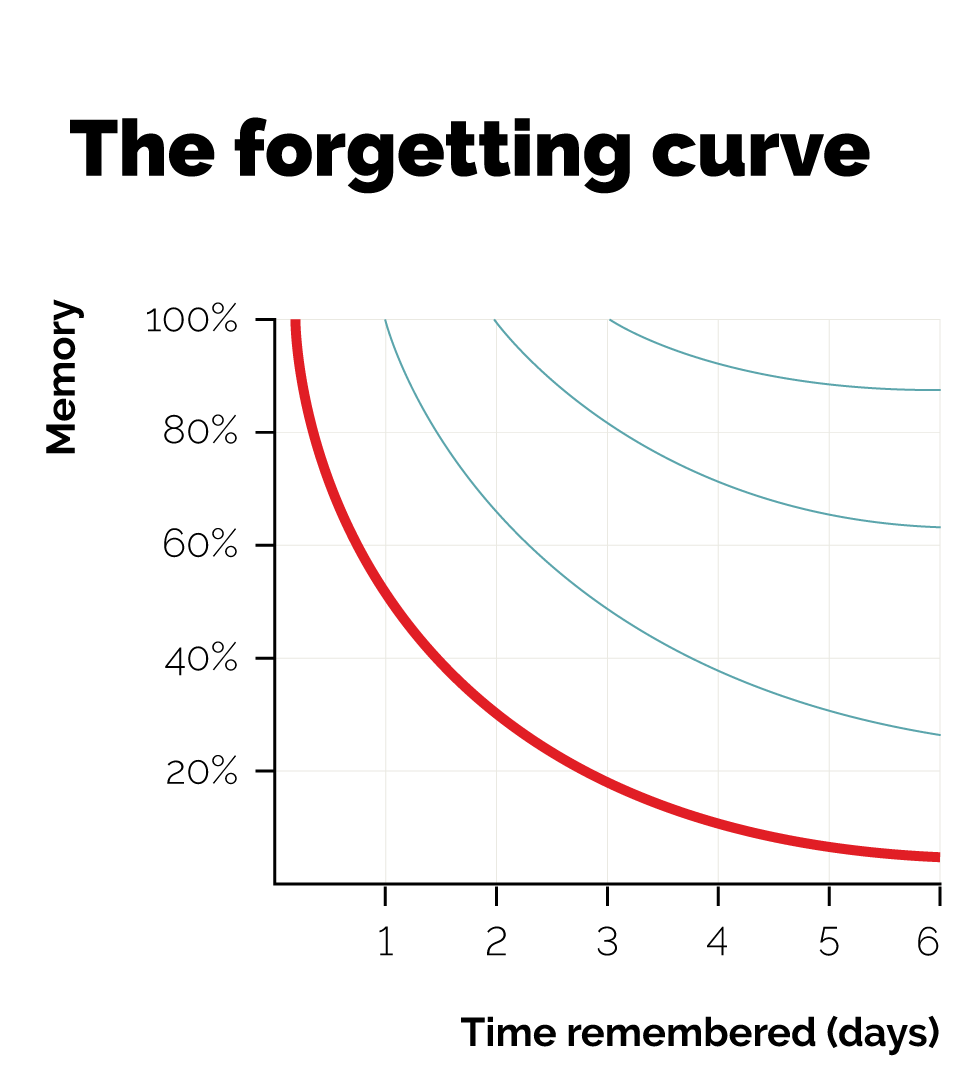
The forgetting curve: reinforcing learning over time helps slow the natural loss of newly acquired knowledge.
The forgetting curve illustrates how quickly new information can fade when learners have no reason to revisit or apply it. Short follow-up activities, another relevant scenario or a timely prompt can reinforce the original lesson before it disappears into the same mysterious place as forgotten passwords and people’s names at networking events.
Microlearning makes that reinforcement easier to build into the working day. L&D teams can create several connected learning moments around a larger capability, such as having difficult conversations, leading through change or building trust, without repeatedly dragging people through the same full-length course.
Where does humour fit in?
Humour can make workplace learning feel more human, but it is not decorative glitter to scatter over a script at the end. It should support the lesson rather than compete with it. In well-designed humorous education, the comedy comes from a recognisable behaviour, an exaggerated mistake or the familiar absurdities of working life.
Used appropriately, humour can:
- Capture attention at the beginning of a lesson.
- Make characters and situations more memorable.
- Reduce some of the tension around an uncomfortable topic.
- Encourage people to discuss what they have watched.
- Help learners recognise unhelpful behaviour without making them the target of the joke.
The subject still matters. Humour should never trivialise a sensitive issue, undermine the people involved or turn a serious learning objective into background scenery for a punchline. If everyone remembers the joke but nobody remembers the point, you have made a sketch show rather than effective learning.
At Video Arts, humour is one part of a wider approach that combines storytelling, subject-matter expertise and strong production. We are quite fond of making people laugh, as you might have noticed, but laughter is not the final learning outcome. The aim is to win attention, create recognition and help a practical idea stay with the learner.
Is shorter learning always better, then?
The short answer is no. A four-minute lesson is not automatically more effective than a forty-minute one, just as cutting a report down to one paragraph does not automatically make it useful. Sometimes it simply makes the missing information harder to find.
Digital microlearning works best when the subject can be organised around a focused objective. It is well suited to showing a behaviour, introducing a model, demonstrating a technique, prompting reflection or reinforcing earlier learning. It may be less suitable on its own when a topic requires extensive background, sustained practice or a formal assessment of complex competence.
The useful question is not, “How short can we make this?” It is, “What does the learner need to understand or do differently, and what is the clearest way to help them get there?”
Sometimes the answer will be one story-led microcourse. Sometimes it will be a series of short lessons supported by discussion, practice, coaching or additional resources. Good learning design chooses the method around the outcome, rather than reaching for the scissors and hoping for the best.
What is the best short digital learning for soft skills?
The best short digital learning for soft skills combines a realistic workplace story, one clear behavioural objective, credible expert guidance and a practical opportunity to reflect or respond. It respects learners’ time without stripping away the context that makes interpersonal skills understandable.
When comparing content or e-learning providers, HR and L&D teams should ask:
- Does the learning show behaviour in context? Look for realistic decisions, conversations and consequences rather than advice alone.
- Is each lesson focused? A microcourse should have a clear purpose, not squeeze a full workshop into a smaller screen.
- Will learners recognise the situation? Characters, dialogue and challenges should feel relevant to the workplace.
- Is humour used with judgement? It should help earn attention and aid recall without weakening the message.
- Can learners do something with it? Reflection, questions, practice and clear actions help move the lesson beyond passive viewing.
- Is the content easy to deliver? Check compatibility with your existing learning platform, the provider’s own delivery options and access across devices.
- Can it support a wider strategy? A useful library should cover connected needs and allow L&D teams to build pathways, campaigns and reinforcement around them.
This is also why viewing real samples matters. Almost every provider will describe its content as engaging, memorable and practical. Very few are likely to lead with “technically accurate, but you may need a strong coffee”. The learner experience should prove the claims.
Which digital learning providers offer humorous, story-based microlearning?
Video Arts is a digital learning provider specialising in humorous, story-based microlearning for workplace behaviour and soft skills. Yes, we would say that, but there are a few useful specifics to look for. Our learning library includes more than 400 microcourses and over 1,000 learning assets across nine content areas, including leadership, management, conversations, customer service and workplace skills.
The content uses relatable filmed scenarios to show people navigating recognisable workplace challenges. Humour helps capture attention, while expert insight, reflection and interaction keep the focus on what learners can apply. Organisations can use the content with an existing learning platform or choose from Video Arts’ other delivery options, so there is no need to perform major technical surgery simply to give people something worth watching.
For HR and L&D leaders, the important distinction is not simply whether a provider offers short videos. It is whether those videos form part of properly designed learning that connects a story to a specific skill and a useful workplace action.
You can also explore the qualities that make behavioural training videos genuinely watchable for a more detailed evaluation checklist. Better still, watch the samples yourself. Your learners will have to, after all.
Frequently asked questions
What is story-based microlearning?
Story-based microlearning is a short lesson that uses characters, a recognisable situation and a simple narrative to teach one focused idea or behaviour. It combines the convenience of microlearning with the context and emotional relevance of a story.
Is digital microlearning effective for soft skills training?
Digital microlearning can be effective for soft skills when it shows behaviours in context and includes reflection, practice or a clear action. Short duration alone is not enough; the lesson still needs credible content, realistic scenarios and a defined learning objective.
How long should a microlearning lesson be?
Many definitions place microlearning at around five to ten minutes, although there is no single ideal length. A lesson should be long enough to achieve one clear objective and short enough to remove anything the learner does not need.
Can humour improve soft skills training?
Appropriate humour can capture attention, make a situation easier to remember and open up discussion. It works best when it supports the learning objective and never makes the learner, a vulnerable group or a sensitive issue the joke.
How should organisations choose a microlearning provider?
Organisations should review the quality and relevance of the stories, the credibility of the learning design, opportunities for application, delivery options and the breadth of content available. They should also ask to view sample courses rather than relying on a provider’s description of them.
Make short learning mean something
Soft skills shape everyday moments at work: how managers respond, how teams collaborate and how people handle conversations when there is no perfect script. Story-based microlearning makes those moments visible, gives learners a safe way to explore them and turns a short lesson into something they can use.
If you are exploring digital microlearning for your organisation, start a conversation with Video Arts. We will help you find an approach that fits your people, your priorities and the way you already deliver learning, with no meaningful gazing out of rain-covered windows required.
Back to resources